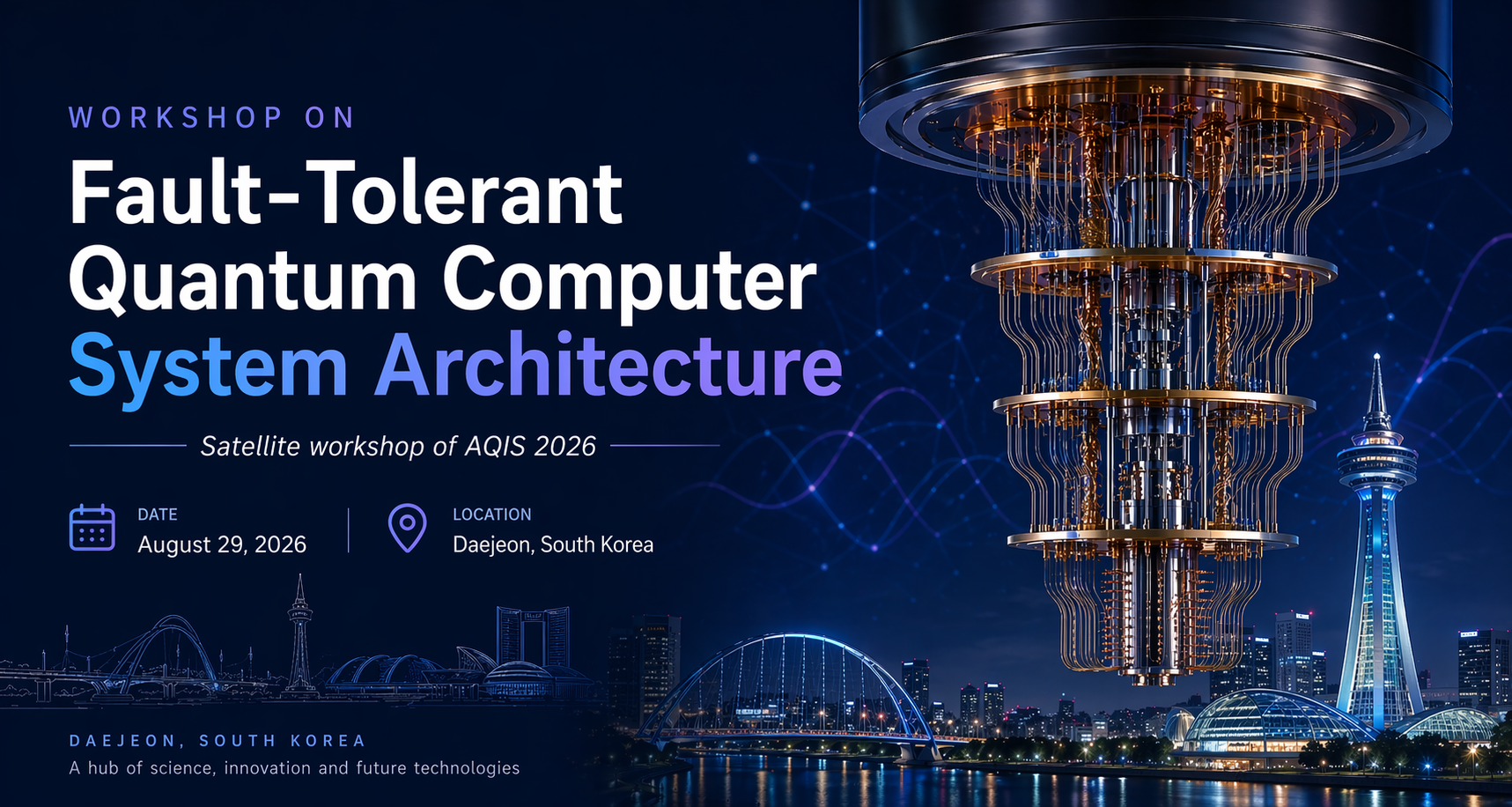
Workshop on Fault-Tolerant Quantum Computer System Architecture
About FTQCSA
The pursuit of Fault-Tolerant Quantum Computer (FTQC) represents a promising direction in enhancing computation capability, with far-reaching implications for various fields. However, the research and development of FTQC necessitate a multidisciplinary approach, drawing on expertise from diverse areas, including quantum coding theory, quantum processing unit design, electronics engineering for quantum-classical interfaces, quantum networks, computer architecture, compilation techniques, and FTQC integration with high-performance computing. As we embark on the path to achieving quantum advantage through FTQC, it is clear that sustained efforts are required to scale up FTQC systems while reducing the resources needed to operate them.
The journey toward harnessing the power of FTQC has just begun, and it is essential to recognize that long-term commitment and collaboration are crucial for overcoming the complex challenges ahead. In this context, the motivation behind this workshop lies in the need to foster international cooperation among researchers from diverse disciplines. The primary objective of this workshop is to provide a platform where experts can converge to share their latest advancements, discuss system-level challenges, and collaborate on strategies to accelerate the development of FTQC systems. By facilitating an exchange of ideas and expertise, we aim to drive progress toward realizing quantum advantages.
Date and Venue
- Date: August 29, 2026
- Venue: Room 212 in the main building (Building No. 101) of KRISS (Korea Research Institute of Standards and Science), 267 Gajeong-Ro, Daejeon (about 4 km from KAIST).
Presentations
- Keynote: Rodney Van Meter (Keio University, Japan)
- Title: Open Problems in Large-Scale, Fault-Tolerant Quantum Computer Architecture
- Invited:
- Naphan Benchasattabuse (Keio University, Japan)
- Title: Space-Time Tradeoffs of Pauli-Based Computation in Distributed qLDPC Architectures
- Abstract: Pauli-based computation (PBC) provides a universal framework for executing fault-tolerant quantum algorithms using Pauli measurements and magic states. In monolithic architectures, the serialized nature of PBC directly ties runtime to a circuit’s T-gate count, making it slow on metrics like circuit depth. However, in distributed quantum computing (DQC), the primary bottleneck is remote Bell pair generation. We investigate the tradeoff between error-correcting code block size and execution time of PBC within the Q-Fly architecture at intermediate scale, limiting individual node capacities to reflect near-term constraints while supplying abundant network nodes to minimize routing and compilation effects. We find that large qLDPC code blocks outperform the surface code baseline in terms of execution time by up to an order of magnitude when evaluated against quantum optimization algorithms. By moving groups of qubits to free nodes to bypass the sequential bottleneck of PBC, the large-block architecture minimizes network operations and achieves faster overall execution. This demonstrates that PBC is a competitive model in the distributed regime, establishing it as a practical compilation baseline for qLDPC systems before invoking more efficient transversal or homological gates.
- Dongmoon Min (Sungkyunkwan University, South Korea)
- Title: Architecting a Quantum Computer As a Computer
- Abstract: In this talk, I will introduce system-level efforts to design practical quantum computers starting from qubits. I will first review recent trends in developing large-scale quantum systems. Then, I will present our end-to-end quantum computer system simulator and scalable quantum computer system architecture. Through this presentation, the audience will understand the ongoing efforts in academia and industry to build the quantum system stack and scalable quantum computers.
- Kosuke Mitarai (Osaka University, Japan)
- Title: Toward Resource-Efficient Algorithms for Quantum Simulation
- Abstract: Fault-tolerant quantum computers are expected to enable accurate simulations of quantum systems that are challenging for classical computers. However, the computational resources required by many quantum algorithms remain substantial, making resource reduction an important step toward practical applications. In this talk, I will present some of our recent efforts toward developing and evaluating resource-efficient algorithms for quantum simulation, with a particular focus on molecular ground-state energy estimation. I will discuss approaches that combine quantum computation with classical information to reduce quantum resources, numerical studies of higher-order product formulas for energy estimation, and fundamental limits on the cost of quantum phase estimation. Through these examples, I will highlight both algorithmic opportunities and practical challenges in reducing the computational cost of quantum simulation on future fault-tolerant quantum computers.
- Naphan Benchasattabuse (Keio University, Japan)
- Posters
- Yuan Haidong, “Optimal measurement and minimal tradeoff in multi-parameter quantum estimation”
- Ryo Mikami, “Overflow-Safe Polylog-Time Parallel Minimum-Weight Perfect Matching Decoder: Toward Experimental Demonstration”
- Kosuke Takayama, “Quantum Gate Scheduling under Gate Parallelism Constraint”
- Minjeong Song, “Exact and approximate conditions of tabletop reversibility: when is Petz recovery cost-free?”
- Taisei Araki, “Latency Evaluation of High-Fidelity Physical EPR Generation Based on Probabilistic Entanglement Distillation Processes”
- YASWITHA GUJJU, “Scalable Closed-Loop Variational Quantum Simulation of Topological Quantum Matter on Superconducting Quantum Processors”
- Hwanghee Kim, “Logical-Class Reversals in Surface-Code MWPM: Intrinsic Ambiguity versus Decoder-Induced Excess”
- Md Abidur Rahman Khan, “Fault-Tolerant Quantum Physical AI: System Architecture for Reliable Autonomous Robots”
- Takumi Kobori, “LSQCA: Resource-Efficient Load/Store Architecture for Limited-Scale Fault-Tolerant Quantum Computing”
- Nusrat Jahan Alve, “A Hierarchical Multi-Agent Reinforcement Learning Framework for Fault-Tolerant Quantum Computing”
- Zhang Yuchen, “Experimental validation of module-based discrete-event simulator of quantum interconnects”
- David Lawrence Bantug Clarino, “XAG Quantum Circuit Synthesis using Dirty Ancillae”
- Denis Jankovic, “The MAGICARP Shooting Method: Smooth Quantum Control at the Weak-Driving Speed Limit”
Registration
Registration is now closed. All participants should have received a participation confirmation email from the FTQCSA Organizing Committee.
Detailed program
- 10:00-10:45: Rodney Van Meter (45min)
- 10:45-11:30: Dongmoon Min (45min)
- 11:30-13:00: Lunch (90min)
- 13:00-13:45: Kosuke Mitarai (45min)
- 13:45-14:30: Naphan Benchasattabuse (45min)
- 14:30-14:40: Break (10min)
- 14:40-15:40: Site visit (60min)
- 15:50-17:00: Poster session (70min)
Organizing Committee
- Chair: Akihito Soeda (National Institute of Informatics, Japan)
- Co-Chair: Jaewan Kim (KRISS, South Korea)
- Vice Chair: Teruo Tanimoto (Kyushu University, Japan)
- Ilkwon Byun (Kyushu University, Japan)
- Eunseong Kim (KAIST, South Korea)
- Shota Nagayama (Keio University, Japan)
- Yasunari Suzuki (RIKEN, Japan)
- Yosuke Ueno (RIKEN, Japan)
- Hayata Yamasaki (The University of Tokyo, Japan)
Endorsed by:
- This workshop is partially supported by “Strategic Research Center for Hyper-Connected Scalable Super-Quantum Computing at KRISS”.
Contact
- Email: ftqcsa-oc at googlegroups.com